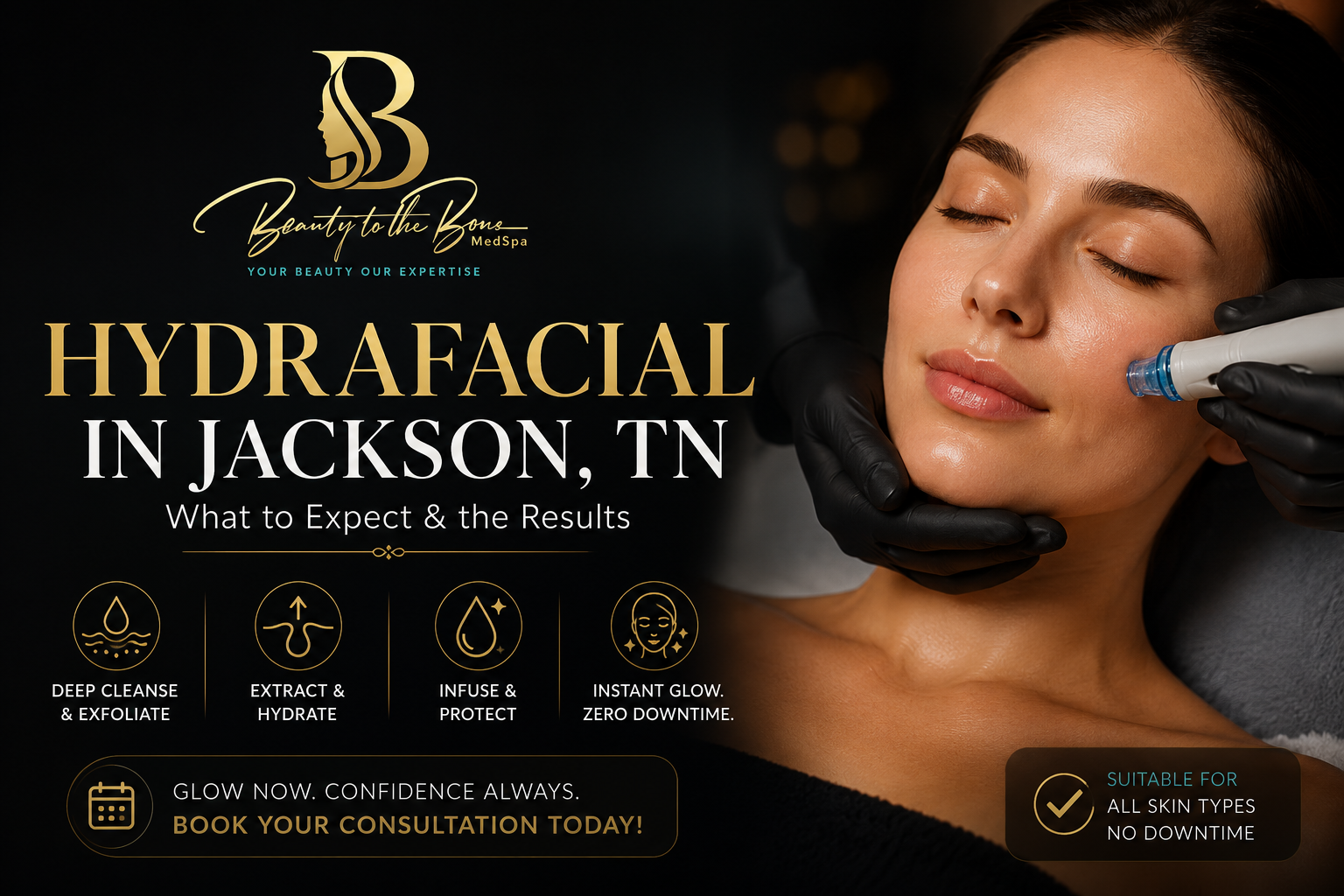
A HydraFacial uses patented Vortex Fusion technology to cleanse, exfoliate, extract, and hydrate the skin in a single 30- to 45-minute session with zero downtime. The visible glow peaks during the first five to seven days, while deeper hydration and clarity typically lasts for three to four weeks before a follow-up session is needed.
HydraFacial is one of several options on our facials menu, and it’s often the first treatment we recommend to clients who want visible results without any recovery time. If you are considering HydraFacial in Jackson, TN, alongside other skin treatments, here is what actually happens during the procedure, why the results last the way they do, and how a licensed provider determines which serums and settings are best suited for your skin.
If your goals lean more toward long-term wrinkle prevention than surface hydration, it’s worth reading our guide on how long Botox results last to see how the two treatments complement each other.
How the HydraFacial Treatment Actually Works
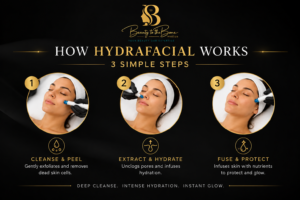
HydraFacial is built around three mechanical steps, each performed with a different handpiece tip.
Step 1: Cleanse and Peel
The first thing we do is use a solution that contains glycolic and salicylic acid. We use this with a peel tip to remove dead skin cells. This method is better than doing it by hand because it does not scratch or irritate the skin. At this stage, the skin starts to look brighter, and the dullness begins to fade.
Step 2: Extract and Hydrate
The next step is what people remember the most. We use a vacuum wand with a spiral tip to remove the impurities clogging the pores. At the same time, it delivers a special hydrating solution into the pores. This is what makes HydraFacial different from machines that simply extract dirt. Our machine removes impurities and infuses moisture in one step.
Step 3: Fuse and Protect
The final step is when we infuse beneficial ingredients into the skin. We use a tool that delivers peptides, antioxidants, and hyaluronic acid into the skin. We do not apply excessive pressure, so the treatment is comfortable. Sometimes, the provider will add a specialized serum to address specific skin concerns. For example:
- Britenol. This is for skin that has spots
- GlySal. This is for skin that is clogged or gets acne
- Growth factor serum. This is, for skin that is starting to get fine lines
Why HydraFacial Results Fade on a Predictable Timeline
The glow you get from a HydraFacial lasts five to seven days. This is because of the skin’s natural renewal cycle. It takes about this long for the top layer of skin to shed and for oil production to return to normal. When this happens, the immediate radiance begins to fade. The deeper hydration, however, continues to work beneath the surface.
An experienced HydraFacial provider knows that there are two things happening: the cosmetic glow and the structural improvement. They are not the same.
What Determines How Your Results Last
There are four things that affect how long your HydraFacial results last. They determine if your results will be at the higher end of the three to six week range.
- Sebum production: If you have balanced skin, your pores will look clearer for longer. This is because the oil helps keep debris out of your pores.
- Barrier condition: If your skin is damaged from exfoliating or using harsh products, it will absorb the hydrating serums quickly. It will also lose them quickly.
- UV exposure: After a HydraFacial, your skin is more sensitive to the sun for 48 to 72 hours. If you don’t protect your skin, the pigmentation may come back faster.
- Booster selection: Different HydraFacial treatments provide different results. For example, a Clarifying HydraFacial with light therapy works differently than a Radiance treatment with brightening serums. So, the timeline of your results depends on the treatment you choose, not your skin type.
HydraFacial vs. Treatments: Which One Actually Fits Your Goal
When choosing between treatments, you need to think about how much correction you want and how much downtime you can handle.
HydraFacial vs. Chemical Peel
HydraFacial works on the top layers of your skin, which means there’s no peeling and no recovery time. A chemical peel goes deeper into your skin using acids to cause a controlled injury. This makes it better for treating acne scars or dark spots. It also means you’ll have to deal with flaking skin for several days.
- Want to look great for an event with no visible recovery time? HydraFacial is a good choice.
- Want to see improvements in your skin texture or scars over several sessions? A chemical peel works better per appointment.
HydraFacial vs. Mesobotox
For concerns rooted in oil gland activity or pore size rather than surface texture, mesobotox works through an entirely different mechanism: superficial botulinum toxin injections that reduce sebaceous gland output over two to four months. Many providers pair the two — a HydraFacial for immediate texture and glow, and mesobotox for longer-term oil control that a topical treatment can’t achieve on its own.
If you have concerns about your skin that are related to oil gland activity, mesobotox may help. It works by using superficial botulinum toxin injections to reduce the amount of oil your skin produces. It can take a few months to see the full effect.
Some doctors combine mesobotox with HydraFacial treatments. The HydraFacial helps improve the skin’s immediate appearance, making it look smoother and more refreshed, while mesobotox helps control excess oil over time. This is something that a cream or lotion cannot achieve on its own.
Who Should (and Shouldn’t) Start With HydraFacial
HydraFacial is an appropriate first treatment for nearly any skin type, including rosacea-prone and sensitive skin, because the mechanical action is gentler than manual extraction or ablative resurfacing.
It is not the right primary tool for:
- Cystic acne
- Deep atrophic scarring
- Significant photoaging
Those conditions respond better to a peel, microneedling, or a laser-based protocol, with HydraFacial layered in as a maintenance treatment between sessions.
Aftercare That Actually Protects Your Results
- Skip retinoids, glycolic or salicylic acid products, and any manual exfoliation for 48 hours so that the freshly cleared pores aren’t immediately re-irritated.
- Apply broad-spectrum SPF 30 or higher on the same day, since the skin’s outer barrier is thinner right after treatment.
- Beyond that, no special restrictions apply, you can wear makeup, exercise, and resume your normal routine the same day.
Ready to Talk to a Provider Instead of Guessing?
At Beauty to the Bone Med Spa, 153 N Star Dr, Jackson, TN 38305, we start every HydraFacial with a hands-on skin assessment so the booster and protocol match what your skin actually needs that day, rather than a one-size-fits-all treatment selected from a menu. Our estheticians work with clients across Jackson and the surrounding West Tennessee area, and many clients pair their HydraFacial with other services from our facials menu or ask about a skincare membership to maintain their glow on a consistent four-to-six-week schedule.
Call us at (731) 499-8694 or book a consultation online to find out which protocol is right for your skin.