If you’ve entered “Botox near me” or “lip filler Jackson TN” into a search engine recently and you’re not alone, you’re not the only one. Injectable treatments have been an increasingly sought-after aesthetic treatments across West Tennessee and with reasons that are legitimate. If they’re performed correctly and by a professional who truly knows the procedure The results can be life-changing in the way you feel after walking out the door.
But here’s the truth that the internet is awash with before and after images, but not a lot of useful, honest facts. What is the real distinction in Botox as well as fillers? How can you tell the quality of a professional? What can you realistically anticipate regarding cost as well as results and recovery?
In Beauty to the Bone Med Spa located in Jackson, TN, we’ve had these conversations with our clients for years and have found that clients make better decisions and get better results and feel more secure in knowing exactly the terms of service they’re signing. Therefore, this guide is created to help you understand the process. No sales pitch. Straight answers.
“The clients who get the most from their treatments are the ones who came in already knowing the right questions to ask.”
If you’re thinking about your first injectable, or you’ve been through treatment elsewhere and wish to be able to see your options clear. This guide will guide you through all the important aspects.
Botox vs. Dermal Fillers — They’re Not the Same Thing
This is the main source of confusion and should be addressed promptly. Botox or dermal fillers both are injectable solutions, however they operate with completely different methods and address distinct issues. Using one when you need the other won’t get you the results you’re hoping for.
How Botox Works
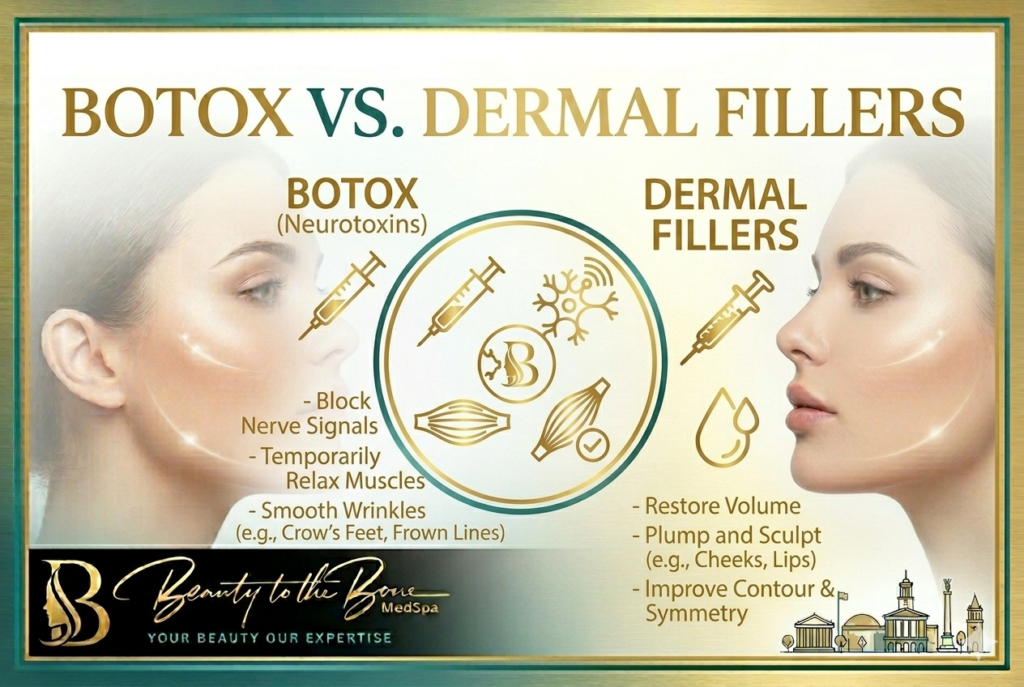
Botox (and its equivalents — Dysport, Xeomin, Daxxify) is a purified neurotoxin. When injected in tiny quantities, precisely it temporarily blocks nerve signals that cause certain muscles in the face to contract. The result is that the muscles relax along with the lines that they make (also known as dynamic wrinkles, are softer or disappear.
Dynamic wrinkles are those that show up whenever you make a face movement. Forehead lines appear when you lift your eyebrows. These are “11s” between your brows when you stare or smile. Your feet are squinting at around the corner of your eye whenever you smile or squint. These are precisely the issues that neurotoxins are made to tackle.
Important clinical distinction: “Botox does not work on wrinkles that remain static which are lines which are visible no matter if your face is still. They are caused by the loss of volume and collagen breakdown. They require a completely different treatment (fillers and skin resurfacing as well as both).”
How Dermal Fillers Work
Dermal fillers are gel-like substances — most commonly hyaluronic acid, a compound your body produces naturally and injected under the skin in order to replenish volume, smooth lines, and improve the contours of your face. In the same way that Botox relaxes muscles, fillers fill in the space.
The most frequently treated areas are those around the mouth (adding size and definition) cheeks (restoring the fullness that has been lost due to age) hollows under the eyes (softening tears) as well as the folds of the nasolabial (the lines that run from the nasal to oral) as well as the jawline as well as the cheeks. Each region requires a distinct filler’s consistency and injecting method that’s why the skill of the practitioner is so important.
| Factor | Botox / Neurotoxins | Dermal Fillers |
| How does it work | Relaxes muscles targeted for relaxation | Creates, restores or adds physical volumes |
| Best for | Dynamic wrinkles (expression lines) Relax | Loss of volume, static lines contouring Volume |
| Results are apparent | 3-7 days, fully effective at 2 weeks | Instantly, with a small amount of swelling lasting 3 to 7 days |
| Duration | 3-4 months, on average | 6-18 months based on the filler and area |
| Reversible? | No, it is a natural process that wears off | Yes (HA fillers are dissolved using the enzyme hyaluronidase) |
| Treatment time | 10-20 minutes | 30-60 minutes based on the area. |
| Downtime | Minimal — bruising possible | The typical time for swelling and bruising is 24-72 hours. |
What to Realistically Expect — Before, During & After
One of the most common sources of disappointment with injectable treatments isn’t the treatment itself. It’s a mismatch between what people expected and what actually happened. Here’s a detailed, step-by-step guide to the whole process.
Consultation – The Step Most People Rush
Before a needle is placed on your skin, a certified doctor should take moments with you. They should evaluate the facial structure, skin’s quality and the volume you have. They should take note of your desires and be open if your goals aren’t in line with what’s clinically feasible. If a visit feels rushed or if a doctor agrees to all of the information without asking questions it’s a red flag.
Day of Treatment
Topical numbing cream may be applied 15–20 minutes before treatment. For Botox injections, they take about 10-15 minutes. Filler sessions typically last 30-60 minutes, depending on the number of areas are treated. The majority of patients describe the experience as a numbing sensation -really not as painful as they thought.
Immediately After – What’s Normal
Botox: tiny, temporary bumps around injection sites which fade within a matter of hours. A slight redness. Rarely, a minor headache will pass within one day. Fillers are prone to swelling immediately and normal — particularly on the lips. The swelling is normal and may take between 5 and 10 days to completely disappear. The results won’t be visible until swelling has subsided.
Days (1-14 ) – The Settling Period
Botox is effective within 3-5 days and will be fully effective approximately two weeks. The swelling of the filler diminishes gradually the majority of patients feel that like they “look like themselves again” on the third day, and the final effect visible on the 10th day of their treatment. The process is quite normal. Don’t be too critical of your performance within the first 48 hours.
Long-Term Maintenance
Botox usually requires refreshing at least every three to four months. Regular treatment over time causes muscles to become less active. This means that some clients will require less of the product to keep the same effect. The longevity of fillers varies. Lips tend to process filler more quickly (6-9 months) as opposed to the jawline and cheeks can remain in place for between 12 and 18 months.
How to Choose a Provider — The Questions That Matter
In Tennessee like many states, the rules for who is able to administer injectable treatments are clear: neurotoxins as well as dermal fillers have to be administered under the supervision of a certified medical expert. This is non-negotiable from a safety standpoint — and it’s the first thing you should verify before booking anywhere.
Beyond the licensing process, here’s what differentiates a trustworthy service from one that is not:
- They do a real consultation — not an instant photo review or a treatment plan. An experienced injector will look at how your face moves, not just what it looks like in a still photo.
- They’ll tell you what they will not do – A expert injector won’t accept requests they feel aren’t appropriate for your anatomy or will not achieve the results you’re hoping for. “Yes” to everything is an indication of a red flag.
- They are able to explain their method and their product selections – Different fillers have distinct characteristics for various purposes. Anyone who is unable to justify why they’re employing a particular product in a certain area probably doesn’t understand why.
- They have a physician on oversight — at a medical spa, there should always be a licensed physician involved in the practice’s medical protocols, even if not present at every appointment.
- They follow up — the relationship doesn’t end when you leave the chair. A person who is invested in your performance will monitor and schedule any necessary touch-ups and be accessible should you have questions.
- They work with FDA-approved products — Ask them specifically about the products they are using and confirm that the products are approved. False as well as “discount” injectables exist and have serious risks.
Risks You Should Understand Clearly
Any doctor who says injectables are risk-free isn’t telling the truth.. The risks are low when treatment is performed correctly . However, they’re real, and you deserve to understand them before you commit.
- Common and expected side effects (these are normal and temporary): The most common side effects are bruising at the site of injection and swelling that is noticeable within 24 hours of filler, a slight sensitiveness or tenderness, bumps, or redness after Botox.
- Less common complications (rare but possible): Asymmetry generally resolvable in an appointment to follow-up. The filler may move away if the technique isn’t perfect. A temporary drooping in the eyelid or brow area with Botox and then disappears when the treatment wears off. The allergic reaction is uncommon however, why an intake form is important.
- Serious complications (very rare, almost always linked to inexperienced injectors): vascular occlusion. A scenario where filler is inadvertently injected into or compresses a blood vessel. The situation is medically critical that needs immediate medical attention. It’s not common with skilled providers who use the correct method, but it is precisely why choosing a skilled medical professional is important.
The most effective method to reduce risk is to choose a qualified, experienced and licensed medical practitioner working within a strict medical framework, not just the one with the lowest cost or highest number of Instagram followers. The difference in cost in the case of an expert injector versus one who is not is significantly less than the cost of correcting a complication.
Cost Guide — What to Expect at B2B
The cost of injectables is not universally applicable. The price of your treatment will depend on what areas you’re working on as well as the amount of product needed, and the treatment plan that your doctor recommends after an examination of your face in the person. This is why we don’t publish an uninspiring price list. An uncontextualized number isn’t a reliable indicator of what the treatment will cost you as we’d rather provide you an accurate estimate at the time of your appointment than an approximate estimate that may not be applicable to your particular situation.
What we can say sincerely: Your appointment with B2B is where genuine price conversations take place. You’ll know exactly what’s recommended, how and how much it will cost without any obligation to sign to the price on the spot.
The smartest way to manage injectable costs long-term: A membership. We at Beauty to the Bone, we provide three levels of membership created to ensure consistent aesthetic treatments truly affordable not something that you must save for appointment-by-appointment.
B2B Silver — $135/month
Our most popular membership. Each month, you will receive a facial and free Dermaplaning (a cost of $600 annually) and 10% off Botox, Dysport, and HA fillers every time you visit. Also includes 25% off laser treatments and 25% off permanent makeup.
B2B Gold — $200/month
Included is one of the most advanced laser treatments each month, customised to meet your goals for skin. Members receive 10% off Botox and fillers, 10% off facials, 10% off skincare products, and 25% off microneedling treatments.
B2B Founders — $199/month
Our most comprehensive membership. It includes an annual B2B Glow Facial every month with a complimentary spray tan, teeth whitening and 10% off Botox and HA fillers. Also, there are discounts on laser packages, skin care and other treatments.
Microneedling using PRP
For members, we offer an exclusive price of $199which is a significant savings over the cost of some of the top sought-after combinations of treatments.
Financing available
For those who wish spreading the costs of their treatment we can offer financing on the services that are eligible. Inquire about this option at the time of booking.
A six-month minimum commitment is applicable for all plans of membership. This minimum is in place for a just reason- true aesthetic benefits are derived from regularity, not one-off appointments. Patients who adhere to a regular basis will usually get better results, lasting longer as opposed to those who schedule appointments infrequently.
A final point about cost: the cheapest injectable available in the room is usually not the best option. The expense of correcting the wrong outcome or handling the issue with an unqualified source is almost always greater than what you’d pay to get it right on the first attempt. It is worthwhile to consider the price. But it shouldn’t be the only factor to consider.
Who Is a Good Candidate?
A majority of healthy adults qualify for filler or neurotoxin treatment. However, there are situations in which we advise waiting or taking alternative options:
- Breastfeeding and pregnancy – both of them are contraindications to injectable treatments. This is a non-negotiable condition.
Active skin infection, cold sores or open wounds on or near the area of treatment. - Certain neurological and autoimmune disorders – a complete health history intake is essential because of this very reason.
- Certain supplements or blood thinners (fish oil, aspirin vitamin E alcohol) used in conjunction with treatment are not always an exclusion, but they are worth examining, since they can increase the risk of bruising.
- Expectations that aren’t realistic If your objective isn’t achievable clinically with injectables, a reputable doctor will inform you and could suggest alternatives instead.
Age isn’t a factor in any direction. People in their 20s can benefit from preventative Botox. Clients who are in the 60s or 70s usually experience significant improvements in quality of life due to careful filler treatments. What is important is your own anatomy and goals as well as your health history, not the age of your body.
Treatments that are injectable and well-executed are among the most satisfying services we provide at B2B. We’ve seen the positive impact it can make. Not only in the way our clients appear but also in how they conduct themselves and how they feel when in a room and when they stop avoiding the camera.
This is what it’s all about. And that’s what we show up every day to help people reach their goals.
Frequently Asked Questions
Q: Can I get Botox and filler on the same day?
A: Yes, combining both of them in one visit is normal and generally fine. It is best to schedule the appointment at least 2 weeks in advance of any major event, so that swelling is fully absorbed.
Q:How do I know how many units of Botox I’ll need?
A: Your provider determines this at your consultation based on your muscle strength and the areas being treated. There’s no reliable number online — it genuinely varies person to person. The injector will explain to you precisely what they’re suggesting before confirming anything.
Q:What should I avoid before my appointment?+
A: Drinking alcohol for 24 hours prior to taking a drink, and stay clear of aspirin, ibuprofen and fish oil or vitamin E several days before -as they increase the risk of bruising. Cleanse your face and stay clear of retinol up to 48 hours before.
Q:Will I look frozen or obviously “done”?
A: No — That look is due to excessive product or poor technique, not Botox itself. A skilled injector applies an appropriate dosage at the right time in the correct locations. The goal at B2B is always to be refreshed as well as natural and not being worked on.
Q:What if I don’t like my results?
A: Botox disappears completely on its own within 3-4 months. Nothing can be permanent. Fillers made of HA can dissolve quickly using hyaluronidase, if required. We can also schedule follow-up appointments to identify and resolve any issues in the early stages.
Q:Is there a “right” age to start Botox?
A: There’s no age limit set -depending on the situation you’re in and the issues that are making you feel uncomfortable. Late 20s are the most common time for prevention, and 30s and 40s are the best time to correct. The ideal time to do this is the one that is appropriate to your appearance, and not just a date on your calendar.
Medical Disclaimer: This content is for informational purposes only and does not constitute medical advice. Please consult a licensed medical provider to determine if Botox, dermal fillers, or other treatments are right for you.